

What to see and do in Krafla?
1. Take in Víti crater and its milky-blue waters
Víti is Krafla’s most striking viewpoint, a crater formed by a phreatic explosion in the early 18th century. As soon as you step out of the car, the air smells of sulfur, and black scoria crunches underfoot. Walk around the rim, with pale blue, almost opaque water spread below you, standing out against the red and ocher crater walls. On a calm day, the silence is complete, broken only by the wind rising from the crater.
The trail is short, but it can be slippery after rain or early in the season. Take your time and stay on the marked path. Here, the ground is fragile and sometimes hot underfoot. For families, it delivers an instant “wow” without a long hike.
2. Walk among the fumaroles of Leirhnjúkur, deep inside the volcano
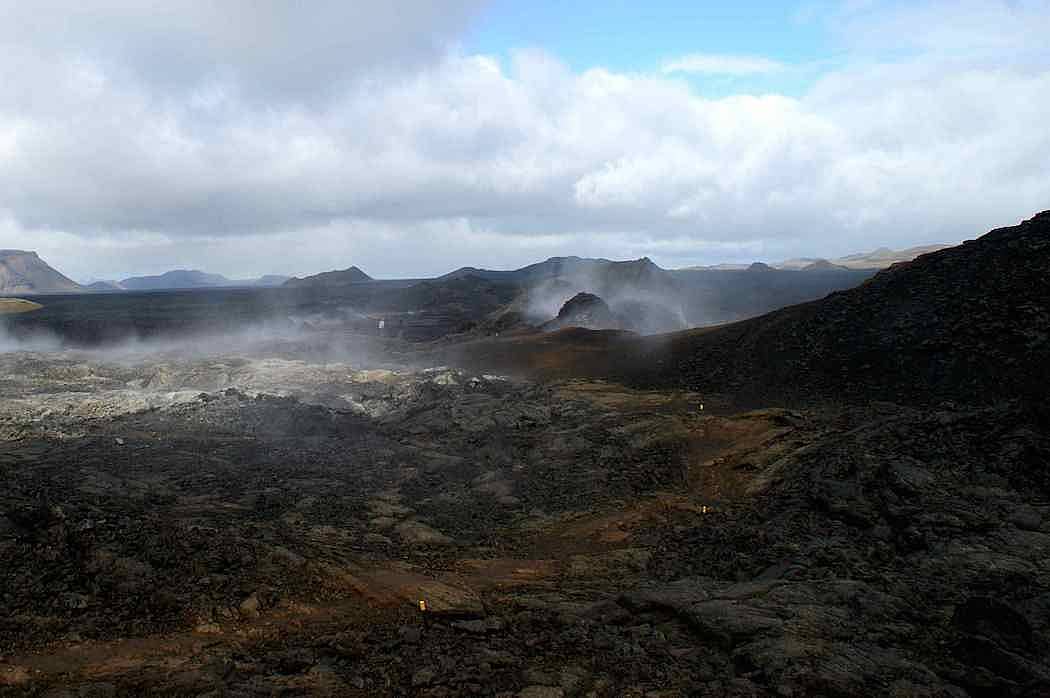
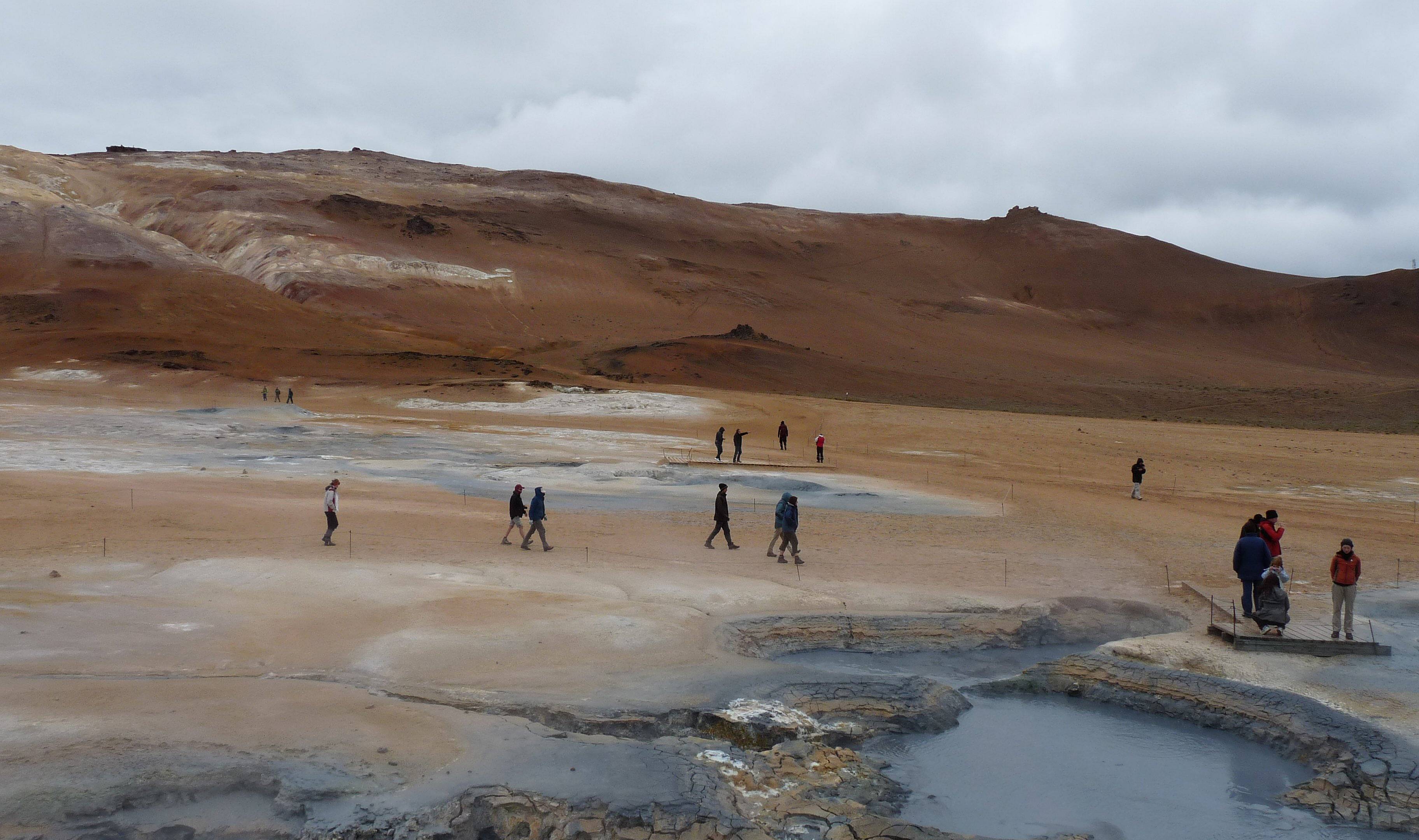
Leirhnjúkur gives you the rare feeling of stepping into a landscape still in the making. Follow a marked path through young lava fields, rippled like cooled metal. As you move forward, the scenery grows wilder, cracks in the ground, bubbling mud, and plumes of steam hissing close to the surface. The smell is sharp and mineral, and heat sometimes rises through the soles of your shoes.
This is where you understand Krafla’s power, shaped by the eruptions of the 1970s and 1980s. Stay strictly on the boardwalks and marked trails. Off trail, the ground can give way. Late in the day, low light brings out every ridge and fold in the lava.
3. Explore Krafla’s lava fields and fissures, in full cinematic scale
At Krafla, the lava forms a maze of textures, from smooth slabs and rope-like flows to jagged blocks. From the parking areas and short trails, you can put together an easy walk, perfect for noticing the details, neon-green moss, porous stones like sponges, and crystals that catch the light. You move slowly, almost as if walking through a living sculpture, looking for fracture lines and tiny craters.
A good tip is to come early, when the area is quiet and the colors stand out more clearly. Avoid climbing on unstable edges and don’t take anything with you. This landscape is best preserved by leaving it untouched.
4. Stop by the geothermal power plant and understand Iceland’s energy
Krafla’s power plant tells the story of modern Iceland, a country that heats its homes with fire from beneath the earth. Even without a long visit, it’s worth stopping for the contrast, pipes, white steam, and black mountains all around. Watch the plumes rise into the cold air and take in the scale of this local resource, powerful but carefully managed. It’s a good moment to talk about geothermal energy, balance, and the way the country lives alongside its volcanoes.
For a more personal approach, ask your local Evaneos agency to include an educational stop in the Mývatn area. Good guides know how to connect science, landscapes, and eruption stories without getting lost in jargon.
5. Soak at Mývatn Nature Baths, the local alternative to the Blue Lagoon
Just a few minutes from Krafla, Mývatn Nature Baths is the ideal hot soak after a walk. Slip into milky-blue water that feels soft on the skin, with a light mineral scent and steam blurring the horizon. Around you, the volcanic plateau stretches out, and the northern wind stings your face while your body relaxes. The hot-cold contrast is addictive, especially at dusk.
Come in the evening to avoid the crowds, or in the off-season to enjoy the quiet. Showering before entering the baths is required, and remember to remove your jewelry, sulfur can tarnish and damage metal.
Our tips for discovering Krafla
Can you climb Krafla, and how difficult is it?
Yes, you can go up to Krafla, but it’s not an alpine-style “climb.” Access is easy by road, followed by walking on marked trails. The difficulty is low to moderate, depending mostly on wind, rain, and areas that may be muddy or snow-covered.
Once you’re there, the experience is felt more through your senses than your legs, the smell of sulfur, warm ground, hissing fumaroles, and milky lakes around Víti. Plan on 30 minutes to 2 hours of total walking, depending on the loops you choose, with little elevation gain but uneven terrain. Wear sturdy shoes, bring a waterproof jacket, and be careful. Stay on the paths, as some crusts are fragile and the geothermal areas can be scalding hot.
Can you hike at Krafla?
Yes, you can hike at Krafla, and it’s one of the most powerful ways to feel the volcano beneath your feet. Around the craters and lava fields, you walk among fumaroles, black rocks that may still feel warm to the touch, and the smell of sulfur, with lunar views over northern Iceland.
The easiest routes are around Leirhnjúkur, Víti, and the geothermal areas, on short to medium marked loops, often one to three hours, with little elevation gain but uneven ground that can be slippery after rain. The best time to visit is from June to September, once the snow patches have melted and the trails are stable. Hiking shoes are essential, and you should stay strictly on the trails, as the ground crust can be fragile and hot.
Where can you see Krafla?
The easiest place to see Krafla is the Leirhnjúkur geothermal area, a ten-minute drive from Reykjahlíð. From there, follow the boardwalks and marked trails, walking among hissing fumaroles, bubbling mud, and blackened rocks that may still be warm. For a wider view, gently climb the small ridges around the field. The view stretches across lava flows, with Lake Mývatn visible in the distance. Avoid fog if you can, as it completely changes the site.
Add Krafla to a tailor-made trip in Iceland
With Evaneos, you’ll work directly with a local, English-speaking expert based in Iceland. They know the roads, the weather that changes in the blink of an eye, the best timing, and reliable places you won’t find with a quick search. The result, you plan your trip with someone on the ground who is truly available.
Want to include Krafla, with its black craters, fumaroles, and hot baths? Your local expert will adapt the route to your interests, pace, and the season, then connect it to the rest of Iceland in a way that feels thoughtful, authentic, and away from the crowds.